
 Yammamh Business Center, Yammamh Road, Jeddah 23436

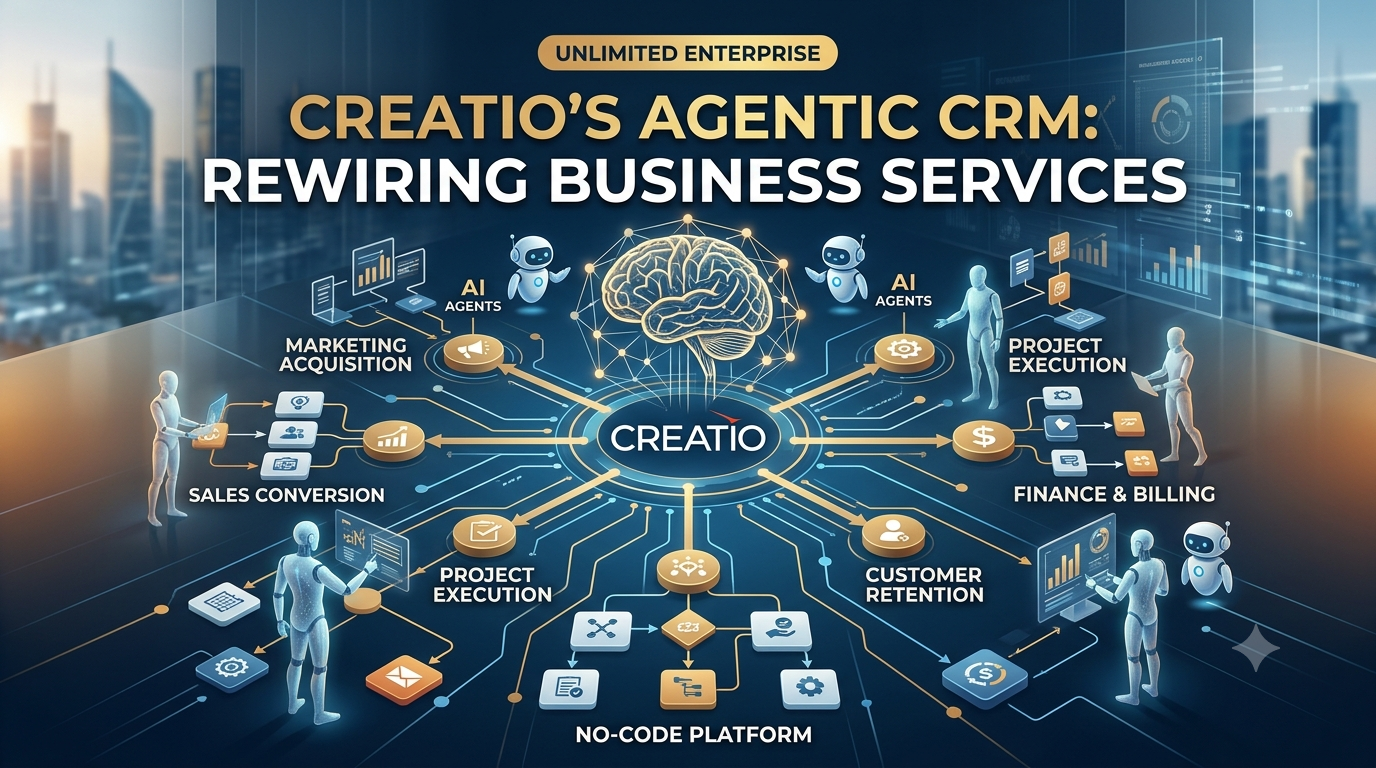
The business services and professional services sector faces a fundamental structural challenge: commercial growth has historically been bound directly to human headcount and billable hours. Traditional Customer Relationship Management (CRM) platforms have failed to resolve this scalability bottleneck. For decades, legacy CRMs have functioned primarily as static digital filing cabinets—requiring exhaustive manual data entry while leaving critical workflows like sales pipeline tracking, project resource allocation, and billing trapped in disconnected departmental silos.
Creatio’s strategic architecture for the Business Services industry directly addresses this operational friction through what the enterprise software industry now categorizes as Agentic CRM. By synthesizing a composable, visual no-code foundation with autonomous AI agents, the platform fundamentally shifts professional services organizations (PSOs) from passively recording historical customer data to actively orchestrating automated, cross-departmental work.
1. The Core Philosophy: The “Unlimited Enterprise” Architecture
Most professional services firms operate on a fragmented software ecosystem: marketing relies on standalone lead generation tools, sales tracks opportunities in a basic CRM, project managers schedule consultants via disconnected spreadsheets, and finance bills clients through separate accounting software. Every transition along the customer lifecycle requires error-prone manual hand-offs.
Creatio replaces this disjointed stack with an AI-native, unified operating platform built on two primary pillars:
- Creatio Studio (No-Code Foundation): Empowering operations directors, practice leads, and project managers to visually design, deploy, and iterate upon intricate service workflows in hours rather than waiting months for customized IT engineering.
- ai (Agentic AI Layer): Embedding autonomous AI agents directly into those operational workflows to intelligently execute routine cognitive tasks—such as parsing complex Request for Proposals (RFPs), generating tailored service quotes, routing multi-tier contract approvals, and proactively identifying budget variance risks.
2. The 8 Pillars of the Business Services Lifecycle
Rather than terminating visibility at the point of contract signature, Creatio maps its operational architecture across the entire commercial and service delivery lifecycle. The framework standardizes execution across eight distinct operational pillars:
| Lifecycle Stage | Primary Stakeholder | Key Agentic Automation & CRM Capabilities |
| Acquisition | Marketing Operations | End-to-end lead lifecycle automation, Account-Based Marketing (ABM) orchestration, event ROI tracking, and automated marketing resource allocation. |
| Conversion | Sales & Business Development | Unified 360-degree client account views, visual RFP workflow customization, Partner Relationship Management (PRM), and automated CPQ (Configure, Price, Quote) generation. |
| Transaction | Order & Contract Management | Centralized service portfolio catalogs, dynamic contract redlining workflows, automated milestone billing triggers, and real-time payment tracking. |
| Execution | Project Management Office (PMO) | Automated project intake routing, task dependency mapping, skill-and-capacity-based resource staffing, and real-time project health dashboarding. |
| Control | Finance & Project Accounting | Digital time and expense capture, automated multi-currency reconciliation, real-time margin recognition, and granular revenue forecasting. |
| Retention | Customer Success & Support | Omnichannel ticketing workspaces, AI-driven sentiment analysis, self-service client reporting portals, and SLA compliance monitoring. |
| Protection | Legal, Risk & Compliance | Automated regulatory governance tracking, GDPR/CCPA data privacy execution, internal audit logging, and conflict-of-interest screening. |
| Operations | Human Resources & Internal Ops | Employee onboarding orchestration, internal service desk automation (travel, hardware, PTO), and specialist certification tracking. |
3. Technical Deep-Dive: How Agentic Automation Orchestrates Handoffs
To understand the true operational leverage of Agentic CRM, consider the transition between the Conversion (Sales) and Execution (PMO) stages. In a conventional environment, an account executive notifies delivery leads via email or Slack once a contract is signed. Project managers then manually review scope documents to assign available personnel.
Within Creatio, an autonomous AI agent continually monitors stage-gate progressions. Upon detecting a “Closed/Won” status on an enterprise opportunity, the system automatically executes a structured workflow trigger:
By executing these sequential actions autonomously, Creatio eliminates administrative latency, ensures zero lost billing days between signing and kickoff, and optimizes billable utilization rates across the firm.
4. Enterprise Evidence: Measurable ROI from the Field
Creatio’s industry framework is validated by substantial enterprise deployments across diverse business service verticals:
- People 2.0 (Global Workforce Deployment): Leveraged Creatio’s composable architecture to consolidate complex sales and customer care workflows globally. The deployment eliminated cross-regional data redundancies and accelerated client onboarding times.
- QTI Group (HR & Staffing Services): United four disparate commercial business units into a single centralized Creatio instance. This consolidation standardized service delivery protocols and significantly improved cross-selling visibility across practice areas.
- BNI & Dealer eProcess (B2B Outsourced Services): Scaled automated lead capture and qualification workflows without sacrificing the high-touch, tailored consulting interactions required in enterprise account management.
5. Executive Takeaway
The competitive landscape of professional and business services is rapidly bifurcating. Firms that attempt to scale by linearly adding administrative headcount will increasingly struggle with margin compression and operational sluggishness. Conversely, market leaders are approaching their service operations as an agile software product—utilizing no-code platforms to adapt service models on demand and deploying agentic AI to automate administrative friction across the entire commercial lifecycle.
Leave a Reply